Separate the publishing decisions
The pipeline checks new links, writes a draft, compares it with recent events, checks its claims and opens an editorial review window. Each stage has a specific decision to make.
Treat AI publishing as an editorial system, with decisions readers can inspect.
Generating text is the easy part. A useful publishing system must recognize repeated stories, check claims against sources and tell readers whether a person actually reviewed the result.
Owner and builder of the product, publishing pipeline and iPhone app.
I can turn an AI feature into an inspectable workflow, including the cases where the right product behavior is to stop and ask for review.
I built nowosci.ai as a Polish and English AI news site, with a pipeline that drafts articles and an iPhone app that also plays them as an audio queue.
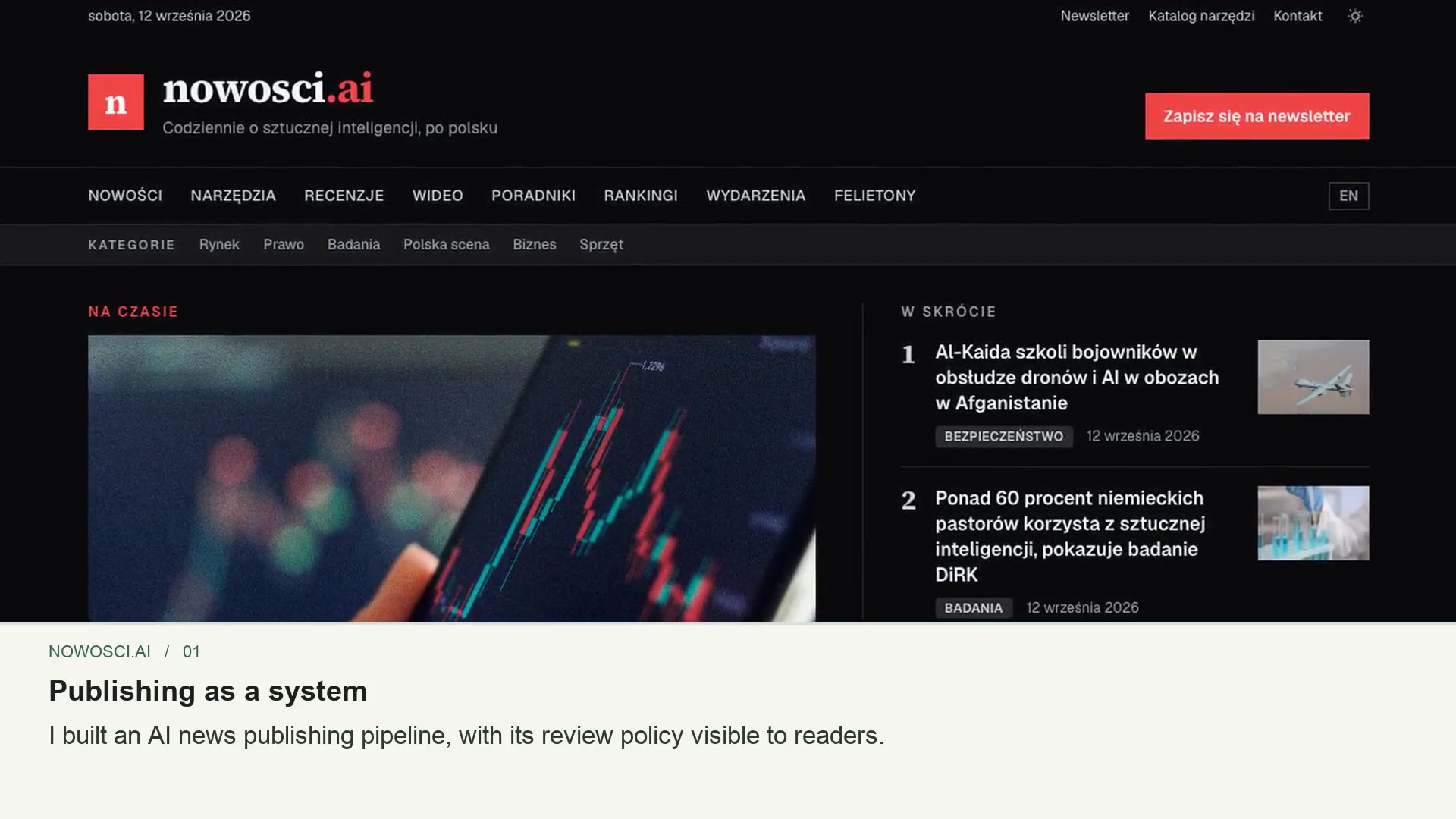
English AI narration · Subtitles included · Play with sound, or read the transcript.
0:00 I built an AI news publishing pipeline, with its review policy visible to readers.
0:08 Each draft gets a review window, and automatic publication is clearly labelled.
0:15 An approved article shows which facts were verified and what the editor changed.
0:23 Approval requires every verification field. This recreated form demonstrates that check.
0:35 The workflow connects source collection, writing, review, fact checking and publication.
0:42 A separate judge checks whether an event is new, a follow-up, or repeated coverage.
0:53 When fact checking fails, drafts stay unpublished. The safeguard stopped one hundred and three drafts.
1:04 Readers can inspect the method, including the limits of automated reporting.
1:11 I also shipped a native iPhone reader. This archived recording includes its earlier audio mode.
1:25 This is the recorded state in October: the pipeline was stalled, with its limits documented.
The pipeline checks new links, writes a draft, compares it with recent events, checks its claims and opens an editorial review window. Each stage has a specific decision to make.
The fact-check gate refuses publication when checks fail or source coverage is incomplete. A repeated story is handled separately from an unverifiable claim, so the system does not treat every failure the same way.
Articles show whether they were reviewed, which fields were approved and what changed later. The review form requires an editor to confirm the title, lead and every body block.
Between 13 and 15 September 2026, the fact-check gate held 103 drafts and published none of them. That is evidence of the publication control working, not a claim that every generated article was correct.
The 6 October 2026 sitemap contained 1,608 Polish articles. A SwiftUI iPhone app has been listed on the App Store since July. The documented pipeline was stalled after 15 September, so this case study focuses on the system and its editorial decisions.
Search metrics use the scope shown with each result. Search position is an average across searches.
Domain property: nowosci.ai (all subdomains)
Open Google Search Console report · Checked 8 Oct 2026
Domain property: nowosci.ai (all subdomains). Provider timezone: America/Los_Angeles.
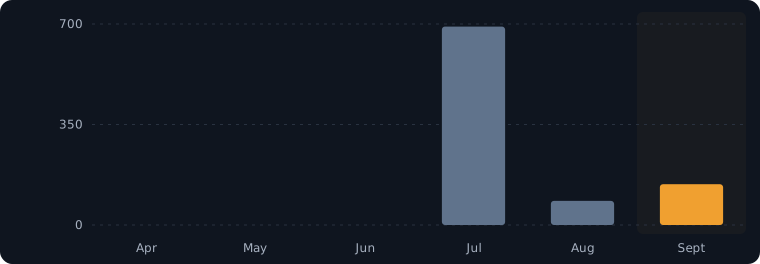
| Month | Google search clicks |
|---|---|
| 1 Apr - 30 Apr 2026 | 0 |
| 1 May - 31 May 2026 | 0 |
| 1 Jun - 30 Jun 2026 | 0 |
| 1 Jul - 31 Jul 2026 | 691 |
| 1 Aug - 31 Aug 2026 | 84 |
| 1 Sept - 30 Sept 2026 | 142 |
nowosci.ai and www.nowosci.ai only · UTC
Recorded activity is affected by consent, blockers, tracking gaps and internal traffic.
| Metric | 7 Sept - 4 Oct 2026 | 10 Aug - 6 Sept 2026 |
|---|---|---|
| Recorded pageviews | 643 | 309 |
| Recorded sessions | 378 | 179 |